
TREATMENTS
Tooth Extraction
What is tooth extraction, when is it needed and how is it performed? Simple vs surgical removal, healing timeline and what aftercare supports recovery?
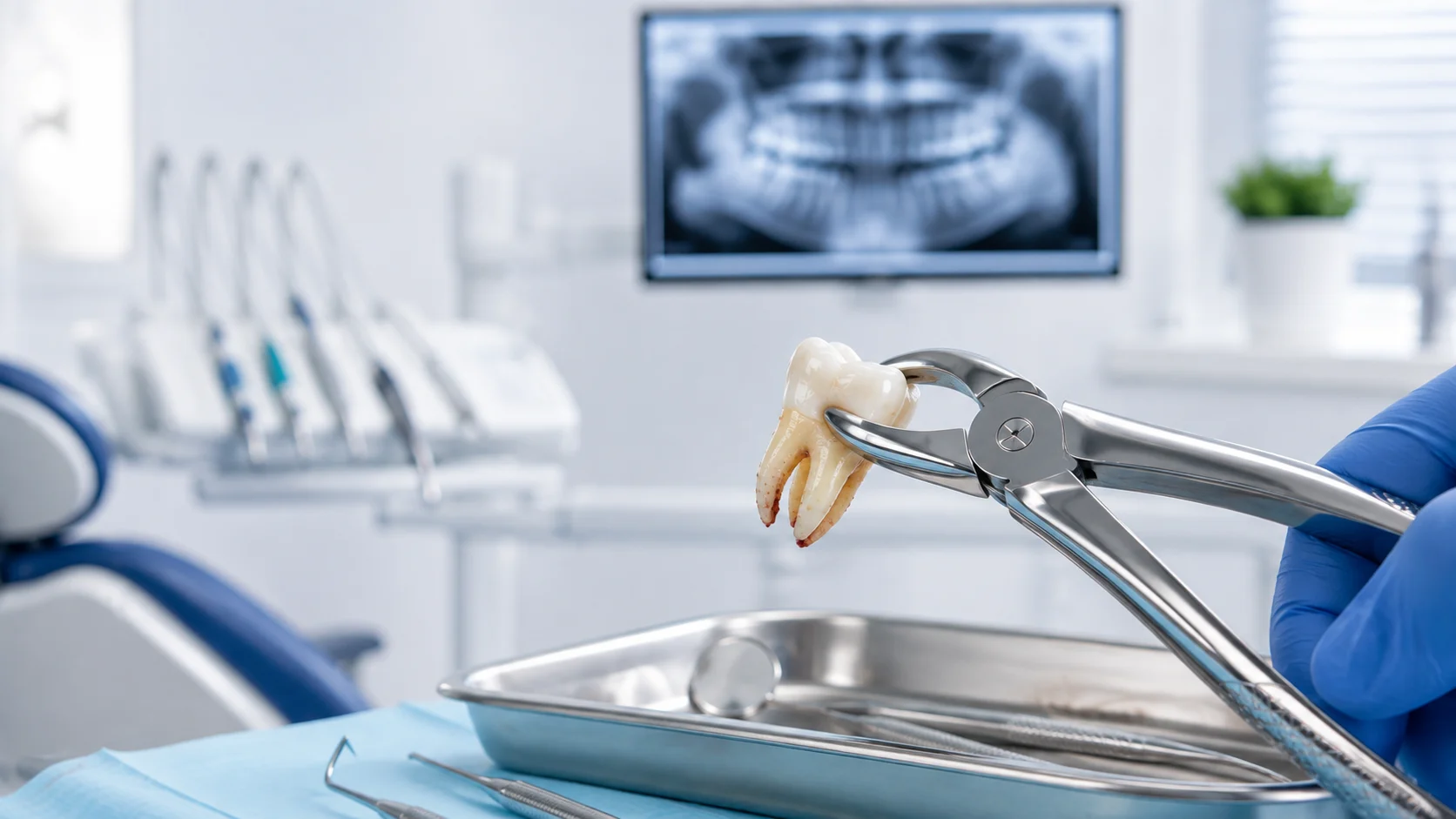
Preserving natural teeth is usually a priority in dentistry. However, some teeth become too damaged to restore safely with fillings, root canal treatment, crowns or other restorative methods. Severe decay, fractures, advanced periodontal disease, infection, impacted teeth or orthodontic requirements can sometimes make extraction necessary.
At Medilife Dent Oral and Dental Health Polyclinic, a tooth is not removed simply because it hurts. Remaining tooth structure, root anatomy, bone support, gum health, infection, restorability and the patient's overall treatment plan are evaluated together.
At our clinic in Beylikdüzü, tooth extraction begins with a dental examination. Radiographs may be used to assess root shape, surrounding bone and the relationship between the tooth and nearby anatomical structures. A simple extraction may be appropriate for some teeth, while more complex cases may require surgical removal.
What Is Tooth Extraction?
Tooth extraction is the controlled removal of a tooth from its socket in the jawbone.
The aim is to remove a tooth that cannot be predictably preserved or that is causing problems for surrounding tissues.
Whenever possible, tooth-preserving treatment options are considered first.
When Might a Tooth Need to Be Extracted?
Possible reasons include:
- Severe tooth decay
- Extensive structural loss
- Fractures extending deep below the gum
- Advanced periodontal bone loss
- Severe tooth mobility
- Recurrent infection
- Selected failed root canal cases
- Impacted teeth
- Partially erupted teeth
- Orthodontic space requirements
- Supernumerary teeth
- Teeth interfering with prosthetic treatment
Not every painful tooth needs extraction.
How Is the Decision to Extract a Tooth Made?
The dentist may assess:
- Extent of decay or fracture
- Root anatomy
- Restorability
- Bone support
- Gum condition
- Presence of infection
- Neighbouring teeth
- Overall treatment plan
Extraction is recommended only when it is considered the most appropriate option.
What Is a Simple Tooth Extraction?
A simple extraction is generally used for a tooth that is fully erupted and can be accessed easily.
It may be suitable when the tooth:
- Is visible in the mouth
- Has accessible crown structure
- Has root anatomy that allows controlled removal
The procedure is carried out under local anaesthesia.
What Is Surgical Tooth Extraction?
Surgical extraction may be needed when a tooth cannot be removed using a straightforward approach.
Examples include:
- Severely broken teeth
- Retained roots
- Impacted teeth
- Partially erupted teeth
- Complex root anatomy
- Teeth covered by bone
A small gum incision, limited bone removal or sectioning of the tooth may be required.
How Is a Tooth Extracted?
1. Examination and Imaging
The tooth and surrounding tissues are assessed.
Radiographs may help evaluate:
2. Local Anaesthesia
The area is numbed.
The goal is to control pain during treatment.
3. Loosening the Tooth
The tooth is gently mobilised using appropriate instruments.
4. Removing the Tooth
The tooth is removed according to its root anatomy.
5. Checking the Socket
The extraction site is inspected and cleaned when necessary.
6. Bleeding Control
Gauze pressure is used.
Sutures may be placed after surgical extraction.
Is Tooth Extraction Painful?
Tooth extraction is generally performed under local anaesthesia.
Patients may feel pressure or movement, but pain control is the goal.
After the anaesthetic wears off, temporary soreness can occur.
How Long Does Tooth Extraction Take?
Treatment time depends on the tooth.
A simple extraction may be relatively quick.
Surgical extraction may take longer depending on:
- Root shape
- Impaction
- Bone density
- Tooth fracture
What Should I Tell My Dentist Before Extraction?
Patients should report:
- Current medications
- Blood thinners
- Medical conditions
- Allergies
- Previous surgical complications
Medication should not be stopped without medical advice.
Can a Tooth Be Extracted While Taking Blood Thinners?
Yes in many cases, but planning must be individualised.
The type and reason for anticoagulant or antiplatelet therapy are important.
Medication should never be stopped without appropriate medical guidance.
Can an Infected Tooth Be Extracted?
Some infected teeth can be removed.
However, treatment depends on:
- Extent of swelling
- Infection severity
- General health
- Ability to achieve adequate anaesthesia
In some situations, infection may need to be controlled first.
The First 24 Hours After Extraction
The first day is important for blood clot formation and early healing.
Common instructions include:
- Bite on gauze as instructed
- Avoid spitting
- Avoid vigorous rinsing
- Avoid straws
- Do not smoke
- Avoid very hot food and drinks
- Do not disturb the socket with the tongue or fingers
How Long Does Bleeding Last?
Mild oozing can continue for a period after extraction.
Persistent heavy bleeding or bleeding that cannot be controlled with pressure should be assessed.
Why Is the Blood Clot Important?
The clot forms inside the extraction socket and protects the underlying tissues.
It supports the early healing process.
Premature loss of the clot can increase the risk of dry socket.
What Is Dry Socket?
Dry socket, or alveolar osteitis, can occur when the blood clot is lost or fails to form properly.
Possible symptoms include:
- Increasing pain several days after extraction
- Pain spreading to the ear or jaw
- Bad taste
- Bad breath
Professional dental care is required.
How Can Dry Socket Risk Be Reduced?
Patients can reduce risk by:
- Avoiding smoking
- Avoiding straws
- Avoiding vigorous rinsing
- Not disturbing the socket
- Following aftercare instructions
Is Swelling Normal After Extraction?
Some swelling can occur, especially after surgical extraction.
It often increases during the early period and then gradually improves.
Increasing swelling, fever or prolonged symptoms should be reviewed.
Can I Use Ice After Tooth Extraction?
Cold application may be recommended in the early period after surgical extraction.
Ice should not be placed directly on the skin.
When Can I Eat After Extraction?
It is usually safer to wait until numbness has worn off before eating.
Early foods may be:
- Soft
- Lukewarm
- Easy to chew
What Foods Should I Avoid?
During the early healing period, patients may need to avoid:
- Very hot foods
- Hard foods
- Small seeds or grains that can enter the socket
- Very spicy foods
- Alcohol
Can I Drink Coffee After Extraction?
Very hot coffee can disturb the early healing environment.
It may be best to avoid hot drinks during the initial period.
Smoking After Extraction
Smoking can interfere with healing and increases the risk of dry socket.
Avoiding tobacco is particularly important after extraction.
Can I Brush My Teeth After Extraction?
Yes.
Oral hygiene should continue.
However, direct brushing of the socket should be avoided initially.
When Can I Rinse My Mouth?
Vigorous rinsing immediately after extraction can disturb the clot.
Gentle rinsing may be started later according to professional instructions.
When Are Stitches Removed?
It depends on the type of suture.
Some dissolve naturally, while others are removed at a follow-up appointment.
How Long Does Pain Last?
Pain duration depends on the complexity of the procedure.
Simple extraction discomfort may settle relatively quickly.
Surgical extraction can cause tenderness for several days.
Increasing pain should be evaluated.
Are Antibiotics Always Needed?
No.
Antibiotics are not routinely required after every extraction.
They are used when there is a specific clinical indication.
Pain Relief After Extraction
Pain medication may be recommended according to the patient's medical history.
Allergies, stomach problems, kidney disease and other medications should be considered.
When Can I Exercise?
Heavy exercise can increase blood pressure and may trigger bleeding.
Strenuous activity is often best avoided during the early healing period.
Flying After Tooth Extraction
Travel plans may need consideration after some surgical extractions, particularly when upper molars are close to the sinus.
Patients planning air travel should mention this before treatment.
Upper Tooth Extraction and the Sinus
Upper molar roots can be close to the maxillary sinus.
Radiographs help assess this relationship.
In selected cases, there may be a risk of communication between the mouth and sinus.
Lower Tooth Extraction and Nerve Position
Lower back teeth can lie close to the inferior alveolar nerve canal.
This is particularly important when evaluating impacted wisdom teeth.
How Are Broken Roots Removed?
If only the root remains, standard extraction may not be possible.
Surgical removal can be required.
Imaging is used to assess root position.
Does Every Root Fragment Need to Be Removed?
Not always.
The dentist may consider:
- Fragment size
- Infection
- Proximity to nerves or sinus
- Risk of removal
Tooth Extraction for Orthodontic Treatment
Some orthodontic cases require additional space.
Selected teeth may be removed to allow alignment.
Not every orthodontic treatment requires extraction.
Extraction of Baby Teeth
Primary teeth may require removal because of:
- Severe decay
- Infection
- Mobility
- Interference with permanent tooth eruption
A space maintainer may sometimes be considered after early loss.
Space Maintainers After Early Tooth Loss
When a baby tooth is lost too early, neighbouring teeth may move into the space.
A space maintainer can preserve room for the permanent tooth in selected children.
What Happens to the Gap After Extraction?
If a permanent tooth space is left untreated for a long time:
- Neighbouring teeth may drift
- Opposing teeth may over-erupt
- Bite balance can change
Long-term tooth replacement planning is therefore important.
What Can Replace an Extracted Tooth?
Options may include:
- Dental implant
- Bridge
- Removable denture
- Orthodontic space closure
The most suitable option depends on the individual case.
When Can an Implant Be Placed?
In some patients, an implant can be placed at the time of extraction.
In others, healing is allowed first.
Timing depends on infection, bone and gum conditions.
Bone Changes After Extraction
The bone around an extracted tooth changes in shape and volume during healing.
Socket preservation or bone grafting may be considered when implant treatment is planned.
What Is Socket Preservation?
Socket preservation uses graft material after extraction to help maintain bone volume.
It is not required for every extraction.
Healing After Tooth Extraction
Healing takes place in stages.
First a blood clot forms.
Then:
- Soft tissue closes
- New tissue develops
- Bone gradually remodels
Complete bone healing takes longer than surface gum healing.
When Should I Contact the Dentist?
Seek professional advice for:
- Increasing pain
- Heavy bleeding
- Fever
- Bad taste or odour
- Significant swelling
- Prolonged numbness
Tooth Extraction in Beylikdüzü
At Medilife Dent Oral and Dental Health Polyclinic, extraction is considered after tooth-preserving options have been evaluated.
Patients visiting from Beylikdüzü, Yakuplu, Adnan Kahveci, Güzelyurt, Barış Mahallesi, Esenyurt, Avcılar, Büyükçekmece and nearby areas can be assessed for severe decay, fractured teeth, infection, periodontal bone loss and conditions requiring surgical extraction.
After examination and necessary imaging, a simple or surgical extraction plan can be prepared.
Tooth Extraction — Quick Information
| Topic | Summary |
|---|---|
| When may it be needed? | It may be considered in advanced decay, major fracture, severe periodontal bone loss, recurrent infection, impacted teeth or some orthodontic cases. |
| Is every painful tooth extracted? | No. In suitable cases, fillings, root canal treatment or other conservative options are evaluated first. |
| How is the extraction decision made? | Remaining sound tooth structure, root anatomy, bone support, infection status and whether the tooth can be restored are assessed together. |
| How is simple vs surgical extraction decided? | It depends on the tooth’s position in the mouth, whether it is fractured, root anatomy and its relationship with bone. |
| Is the procedure painful? | It is usually performed under local anaesthesia. Pressure may be felt during treatment; temporary pain or sensitivity may occur afterward. |
| How long does it take? | Simple extractions may be shorter; surgical extractions vary according to case complexity. |
| Is post-extraction bleeding normal? | Mild oozing may occur for a while. Heavy or persistent bleeding should be evaluated. |
| Can swelling occur afterward? | Temporary swelling may occur, especially after surgical extractions. |
| When can you eat? | Soft, lukewarm foods may be preferred after the numbness from local anaesthesia wears off. |
| Can you smoke? | It is not recommended. Smoking may impair healing and increase dry socket risk. |
| Are antibiotics needed? | They are not required after every extraction. Need is determined according to the clinical situation. |
| Are sutures needed? | Usually not in simple extractions; they may be used in surgical cases. |
| How long does healing take? | Soft tissue healing is shorter, while complete bone remodelling may take longer. |
| What happens to the empty space? | If left empty for a long time, neighbouring teeth may drift or the opposing tooth may over-erupt. |
| What can replace the extracted tooth? | Implants, bridges, removable dentures or orthodontic space closure may be considered in suitable cases. |
Difference Between Simple and Surgical Tooth Extraction
| Feature | Simple Extraction | Surgical Extraction |
|---|---|---|
| When it applies | Visible, easily accessible teeth in the mouth | Impacted, fractured, deeply rooted or hard-to-reach teeth |
| Gum incision needed? | Usually no | May be required |
| Bone removal needed? | Usually no | May be required in some cases |
| Is the tooth sectioned? | Usually not | The tooth may be divided into sections when needed |
| Local anaesthesia used? | Yes | Yes |
| Procedure time | Usually shorter | May take longer |
| Sutures needed? | Usually not | Often required |
| Swelling risk | Usually less | May be more noticeable |
| Healing process | Often shorter and more comfortable in most cases | A longer recovery period may be needed |
| Follow-up need | Depends on the case | More frequent review may be needed due to sutures and the surgical site |
| Radiographic assessment | Performed when needed | More important because of roots and surrounding anatomy |
| Primary goal | To remove an accessible tooth in a controlled way | To safely remove a tooth under complex anatomical conditions |
Frequently Asked Questions About Tooth Extraction
Consider Safe Extraction When a Tooth Cannot Be Preserved
Severe decay, fractures, recurrent infection or advanced periodontal support loss can sometimes make extraction necessary.
However, tooth-preserving options should be considered first whenever possible.
Extraction decisions should be made after evaluating tooth structure, infection status and the overall treatment plan.
ARTICLES
More articles
Other guides on oral and dental health you may want to read next.
 Oral Health
Root Canal Treatment: A Modern Way to Save a Natural Tooth
Learn how root canal treatment works, when it may be needed, what recovery looks like, and how proper restoration and aftercare help protect the tooth.
Read article Teeth Whitening
Teeth Whitening Methods: In-Office and At-Home Whitening Guide
Learn about in-office and at-home teeth whitening, treatment steps, differences between methods, longevity, sensitivity, and aftercare.
Read article Orthodontics
Clear Aligners vs Braces: Which Is More Suitable for You?
Clear aligners or braces? Compare both orthodontic treatments in terms of appearance, comfort, oral hygiene, treatment process, and suitability.
Read article Implant
What Is a Dental Implant? How Does Implant Treatment Work?
Learn what a dental implant is, how implant treatment works, how long it takes, who it is suitable for, and what to expect during recovery.
Read articleOral HealthRoot Canal Treatment: A Modern Way to Save a Natural Tooth
Learn how root canal treatment works, when it may be needed, what recovery looks like, and how proper restoration and aftercare help protect the tooth.
Read articleTeeth WhiteningTeeth Whitening Methods: In-Office and At-Home Whitening Guide
Learn about in-office and at-home teeth whitening, treatment steps, differences between methods, longevity, sensitivity, and aftercare.
Read articleOrthodonticsClear Aligners vs Braces: Which Is More Suitable for You?
Clear aligners or braces? Compare both orthodontic treatments in terms of appearance, comfort, oral hygiene, treatment process, and suitability.
Read articleImplantWhat Is a Dental Implant? How Does Implant Treatment Work?
Learn what a dental implant is, how implant treatment works, how long it takes, who it is suitable for, and what to expect during recovery.
Read articlePATIENT STORIES
What Do Our Patients Say?

Trustindex verified badge is the Universal Symbol of Trust. Only the greatest companies can get the verified badge with a review score above 4.5, based on customer reviews over the past 12 months. About the Trustindex verified badge
Zeynep Karaca
2 weeks ago
I went for a check-up and cleaning. They explained what would be done beforehand and briefly noted what I should watch for afterward.

Emre T.
3 weeks ago
I came for a chip on my front tooth. The color match was more natural than I expected and the procedure took less time than I thought.
Gizem Nur
1 month ago
At the first examination they listened without rushing. Price, timeline and alternatives were discussed openly, which made deciding easier.
Levent B.
2 months ago
I had consulted several places for an implant. Planning here was clearer; they walked me through the entire process on the scan.

Seda U.
3 months ago
I was worried whitening would look too artificial. The result was clean and natural, and sensitivity passed quickly.
Mohammad Asif N...
4 months ago
One of the best services I've received. Our dentist explained the treatment very clearly and made me feel confident at every step. I was seen on time and post-exam care instructions were shared as well.
Barış Yalçın
4 months ago
My follow-up appointment went very smoothly. My dentist explained the planned procedures clearly and the team stayed attentive throughout.
Katie S
4 months ago
I was relieved to find Medilife Dent for an urgent dental issue. I was anxious but the team was very helpful. They explained everything in plain language before treatment and I felt safe throughout.
kadir erol
5 months ago
I visited the clinic and had a good experience. I was nervous at first but the process was very comfortable. Cleanliness, communication and the doctor's approach exceeded my expectations.
Elif A.
6 months ago
During my smile design journey every option was explained calmly and clearly. I'm very happy with the result. They listened to my feedback at the trial stage and paid attention to small details.
Mert Yılmaz
7 months ago
I was worried before implant treatment but planning, communication and follow-up were very professional. They called after surgery to check on me, which built trust.
Ayşe Demir
7 months ago
My cleaning and check-up appointment was very comfortable. The clinic is well organized, the team is attentive and explanations were easy to understand.

Burak K.
8 months ago
I went for root canal treatment. Pain was controlled quickly and they followed up with a call afterward. I expected a long process but appointments were well planned.
Selin T.
8 months ago
At my orthodontics consultation the full process, timeline and payment options were shared clearly. I felt safe.

Can Öztürk
9 months ago
I appreciated that they kept appointment times and gave detailed information. I recommend them.
Derya K.
9 months ago
We chose them for my child's first dental visit. The team was very patient, gave time to ease fear and the check-up went smoothly.
Ahmet Şahin
10 months ago
I was very satisfied with both aesthetics and comfort for my filling. Color match was natural and I had no sensitivity afterward.
Neslihan P.
10 months ago
I went for teeth whitening. The result wasn't exaggerated — it looked natural and clean. Home care instructions were explained in detail.
Okan R.
11 months ago
I applied for a gum issue. The examination was thorough and the treatment plan was explained step by step.
Funda E.
11 months ago
Everyone at the clinic is very attentive. Pre-appointment guidance, explanations during treatment and follow-up were truly professional.